Page Last Updated: November 13, 2025
Diffusion MRI (dMRI)🔗
Release Data🔗
Diffusion MRI release data include both file-based (raw and processed data files in modality-specific formats) and tabulated (instrument and derived data in a standardized table format) data.
See the Data Structure Overview for a full explanation of these data types.
- Raw BIDS stored under subject- and session-specific
dwi/folders - Derivatives generated by QSIPrep and QSIRecon pipelines
- Tabulated data derived from pipeline outputs — see the full list of tables here
Raw diffusion files include DWI runs (*_dwi.nii.gz), magnitude (bval) and orientation (bvec) of the diffusion gradients for each volume, and single-band reference files (*_sbref.nii.gz), all acquired in AP and PA phase encoding directions (dir-<AP|PA>). See BIDS Conversion Procedures.
dwi/
|__ sub-{ID}_ses-{V0X}_dir-<AP|PA>_run-{X}_dwi.bval
|__ sub-{ID}_ses-{V0X}_dir-<AP|PA>_run-{X}_dwi.bvec
|__ sub-{ID}_ses-{V0X}_dir-<AP|PA>_run-{X}_dwi.nii.gz
|__ sub-{ID}_ses-{V0X}_dir-<AP|PA>_run-{X}_dwi.json
|__ sub-{ID}_ses-{V0X}_dir-<AP|PA>_run-{X}_sbref.json
|__ sub-{ID}_ses-{V0X}_dir-<AP|PA>_run-{X}_sbref.nii.gz
QSIPrep preprocesses data to feed into QSIRecon reconstruction workflows. See Data Processing for details.
hbcd/
|__ derivatives/
    |__ qsiprep/
        |__ sub-{ID}/
            |__ log/
            |__ ses-{V0X}/
                |__ anat/
                |   |__ sub-{ID}_ses-{V0X}_from-ACPC_to-anat_mode-image_xfm.mat
                |   |__ sub-{ID}_ses-{V0X}_from-ACPC_to-MNIInfant+1_mode-image_xfm.h5
                |   |__ sub-{ID}_ses-{V0X}_from-anat_to-ACPC_mode-image_xfm.mat
                |   |__ sub-{ID}_ses-{V0X}_from-MNIInfant+1_to-ACPC_mode-image_xfm.h5
                |   |__ sub-{ID}_ses-{V0X}_from-orig_to-anat_mode-image_xfm.txt
                |   |__ sub-{ID}_ses-{V0X}_space-ACPC_desc-aseg_dseg.nii.gz
                |   |__ sub-{ID}_ses-{V0X}_space-ACPC_desc-brain_mask.nii.gz
                |   |__ sub-{ID}_ses-{V0X}_space-ACPC_desc-preproc_T2w.json
                |   |__ sub-{ID}_ses-{V0X}_space-ACPC_desc-preproc_T2w.nii.gz
                |   |__ sub-{ID}_ses-{V0X}_space-ACPC_dseg.nii.gz
                |
                |__ dwi/
                |   |__ sub-{ID}_ses-{V0X}_desc-confounds_timeseries.tsv
                |   |__ sub-{ID}_ses-{V0X}_desc-desc-pepolar_qc.tsv
                |   |__ sub-{ID}_ses-{V0X}_space-ACPC_desc-brain_mask.nii.gz
                |   |__ sub-{ID}_ses-{V0X}_space-ACPC_desc-image_qc.tsv
                |   |__ sub-{ID}_ses-{V0X}_space-ACPC_desc-preproc_dwi.b
                |   |__ sub-{ID}_ses-{V0X}_space-ACPC_desc-preproc_dwi.b_table.txt
                |   |__ sub-{ID}_ses-{V0X}_space-ACPC_desc-preproc_dwi.bval
                |   |__ sub-{ID}_ses-{V0X}_space-ACPC_desc-preproc_dwi.bvec
                |   |__ sub-{ID}_ses-{V0X}_space-ACPC_desc-preproc_dwi.nii.gz (+JSON)
                |   |__ sub-{ID}_ses-{V0X}_space-ACPC_desc-slice_qc.json
                |   |__ sub-{ID}_ses-{V0X}_space-ACPC_dwiref.nii.gz
                |   |__ sub-{ID}_ses-{V0X}_space-ACPC_model-eddy_stat-cnr_dwimap.nii.gz (+JSON)
                |
                |__ figures/
                |__ sub-{ID}_ses-{V0X}.html
QSIRecon has separate derivative folders for each reconstruction workflow. The qsirecon/ folder itself contains only a log folder with metadata for the reconstruction workflows executed. See the following sections for workflow-specific outputs stored in self-contained derivatives folders and Data Processing for details.
hbcd/
|__ derivatives/
    |__ qsirecon/
        |__ sub-{ID}
            |__ log/
                |__ {YYYYMMDD-HHMMSS_UUID}/
                    |__ qsirecon.toml
                    |__ recon_spec.yaml
QSIRecon-DSIStudio runs DSI Studio to generate DTI maps. See Data Processing for details.
hbcd/
|_ derivatives/
   |_ qsirecon-DSIStudio/
      |_ sub-{ID}/
         |_ ses-{V0X}/
            |_ dwi/
            |  |_ sub-{ID}_ses-{V0X}_space-ACPC_bundles-DSIStudio_scalarstats.tsv
            |  |_ sub-{ID}_ses-{V0X}_space-ACPC_bundles-DSIStudio_tdistats.tsv
            |  |_ sub-{ID}_ses-{V0X}_space-ACPC_model-gqi_bundle-Association<ASSOC><L|R>_streamlines.tck.gz
            |  |_ sub-{ID}_ses-{V0X}_space-ACPC_model-gqi_bundle-Cerebellum<CEREB>_streamlines.tck.gz
            |  |_ sub-{ID}_ses-{V0X}_space-ACPC_model-gqi_bundle-CommissureAnteriorCommissure_streamlines.tck.gz
            |  |_ sub-{ID}_ses-{V0X}_space-ACPC_model-gqi_bundle-CommissureCorpusCallosum_streamlines.tck.gz
            |  |_ sub-{ID}_ses-{V0X}_space-ACPC_model-gqi_bundle-ProjectionBasalGanglia<BG><L|R>_streamlines.tck.gz
            |  |_ sub-{ID}_ses-{V0X}_space-ACPC_model-gqi_bundle-ProjectionBrainstem<BRAINSTEM>_streamlines.tck.gz
            |  |_ sub-{ID}_ses-{V0X}_space-ACPC_model-gqi_bundlestats.csv
            |  |_ sub-{ID}_ses-{V0X}_space-ACPC_model-gqi_dwimap.fib.gz
            |  |_ sub-{ID}_ses-{V0X}_space-ACPC_model-gqi_dwimap.fib.gz.icbm152_adult.map.gz
            |  |_ sub-{ID}_ses-{V0X}_space-ACPC_model-gqi_param-<gfa|iso>_dwimap.nii.gz
            |  |_ sub-{ID}_ses-{V0X}_space-ACPC_model-gqi_param-qa_dwimap.nii.gz
            |  |_ sub-{ID}_ses-{V0X}_space-ACPC_model-gqi_param-qa_dwimap.json
            |  |_ sub-{ID}_ses-{V0X}_space-<ACPC|MNIInfant+1>_model-rdi_param-<rd1|rd2>_dwimap.nii.gz
            |  |_ sub-{ID}_ses-{V0X}_space-<ACPC|MNIInfant+1>_model-tensor_param-<ad|fa|ha|md|rd>_dwimap.nii.gz
            |  |_ sub-{ID}_ses-{V0X}_space-<ACPC|MNIInfant+1>_model-tensor_param-t<xx|xy|xz|yy|yz|zz>_dwimap.nii.gz
            |  |_ sub-{ID}_ses-{V0X}_space-MNIInfant+1_model-gqi_param-<gfa|iso|qa>_dwimap.nii.gz
            |
            |_ figures/
            |_ sub-{ID}_ses-{V0X}.html
| BIDS Entity | Values |
|---|---|
| <ASSOC> |
ArcuateFasciculus
Cingulum
ExtremeCapsule
FrontalAslantTract
HippocampusAlveus
InferiorFrontoOccipitalFasciculus
<Inferior|Middle|Superior>LongitudinalFasciculus
ParietalAslantTract
AssociationUncinateFasciculus
VerticalOccipitalFasciculus
|
| <CEREB> |
Cerebellum (L/R)
InferiorCerebellarPeduncle (L/R)
MiddleCerebellarPeduncle
SuperiorCerebellarPeduncle
Vermis
|
| <BG> |
AcousticRadiation
AnsaLenticularis
AnsaSubthalamica
CorticostriatalTract
FasciculusLenticularis
FasciculusSubthalamicus
Fornix
OpticRadiation
ThalamicRadiation
|
| <BRAINSTEM> |
CorticobulbarTract (L/R)
CorticopontineTract (L/R)
CorticospinalTract (L/R)
DentatorubrothalamicTractrl
MedialForebrainBundle (L/R)
MedialLemniscus (L/R)
NonDecussatingDentatorubrothalamicTract (L/R)
ReticularTract (L/R)
|
QSIRecon-DIPYDKI runs DIPY to generate DKI maps. See Data Processing for details.
hbcd/
|_ derivatives/
   |_ qsirecon-DIPYDKI/
      |_ sub-{ID}/
         |_ ses-{V0X}/
            |_ dwi/
            |  |_ sub-{ID}_ses-{V0X}_space-ACPC_bundles-DSIStudio_scalarstats.tsv
            |  |_ sub-{ID}_ses-{V0X}_space-<ACPC|MNIInfant+1>_model-dki_param-ad|ak|kfa|md|mk|mkt|rd|rk_dwimap.nii.gz
            |  |_ sub-{ID}_ses-{V0X}_space-<ACPC|MNIInfant+1>_model-dki_param-ad|ak|kfa|md|mk|mkt|rd|rk_dwimap.json
            |  |_ sub-{ID}_ses-{V0X}_space-<ACPC|MNIInfant+1>_model-tensor_param-fa_dwimap.nii.gz
            |  |_ sub-{ID}_ses-{V0X}_space-<ACPC|MNIInfant+1>_model-tensor_param-fa_dwimap.json
            |
            |_ figures/
            |_ sub-{ID}_ses-{V0X}.html
TORTOISE calculates MAP-MRI and Tensor fits and scalar maps. See Data Processing for details.
hbcd/
|_ derivatives/
   |_ qsirecon-TORTOISE_model-MAPMRI/
   |  |_ sub-{ID}/
   |     |_ ses-{V0X}/
   |        |_ dwi/
   |        | |_ sub-{ID}_ses-{V0X}_space-ACPC_bundles-DSIStudio_scalarstats.tsv
   |        | |_ sub-{ID}_ses-{V0X}_space-<ACPC|MNIInfant+1>_model-mapmri_param-<MAPMRI>_dwimap.nii.gz (+JSON)
   |        | |_ sub-{ID}_ses-{V0X}_space-<ACPC|MNIInfant+1>_model-tensor_param-<TENSOR>_dwimap.nii.gz (+JSON)
   |        |
   |        |_ figures/
   |        |_ sub-{ID}_ses-{V0X}.html
   |
   |_ qsirecon-TORTOISE_model-tensor/
      |_ sub-{ID}/
         |_ ses-{V0X}/
            |_ dwi/
               |_ sub-{ID}_ses-{V0X}_space-ACPC_bundles-DSIStudio_scalarstats.tsv
               |_ sub-{ID}_ses-{V0X}_space-MNIInfant+1_model-tensor_param-ad|am|fa|li|rd_dwimap.nii.gz
               |_ sub-{ID}_ses-{V0X}_space-MNIInfant+1_model-tensor_param-ad|am|fa|li|rd_dwimap.json

# Label Values Legend
<MAPMRI>: ng, ngpar, ngperp, pa, path, rtap, rtop, rtpp
<TENSOR>: ad, am, fa, li, rd
Data Acquisition🔗
Diffusion-Weighted Imaging (DWI) data is provided in raw BIDS format as outlined in the raw BIDS file tree above. The DWI protocol provides diffusion-weighted images that may be used to estimate multiple models of diffusion behavior in the central nervous system. The protocol acquires roughly 140 diffusion-weighted echo planar images at four b-values (diffusion-weighting) between 0 and 3000 s/mm^2 (12-13 minutes total acquisition time). For raw image acquisition, a minimum of 60% of the diffusion-weighted volumes are required to be collected for the acquisition to be deemed successful.
Data Processing🔗
Diffusion data are preprocessed through QSIPrep, which performs head motion correction, susceptibility distortion correction, MP-PCA denoising, co-registration to T1w images, ANTS spatial normalization, and tissue segmentation (Cieslak et al. 2021). QSIPrep derivatives are then passed to QSIRecon, which executes a curated set of reconstruction workflows, including ODF/FOD reconstruction, tractography, Fixel estimation, and regional connectivity. Multiple QSIRecon derivative folders are provided, each corresponding to a different reconstruction method or model. The diffusion encoding enables the estimation of multiple diffusion MRI models to create the derived data, including:
| Model | Description | Derivatives |
|---|---|---|
| DTIDiffusion Tensor Imaging | Models diffusion with a 3D Gaussian distribution of water displacements. Key outputs include Fractional Anisotropy (FA: anisotropic diffusion, typically higher in white matter bundles with dense, parallel fibers) and Mean Diffusivity (MD: the directionally averaged apparent diffusion coefficient, inversely related to cellular membrane density) (Basser 1994). | qsirecon- DSIStudio |
| DKIDiffusion Kurtosis Imaging | Extends DTI to capture non-Gaussian diffusion. Main metric: MK (mean kurtosis), which is more sensitive to complex or restricted diffusion and often higher in dense white matter (Jensen 2005). | qsirecon- DIPYDKI |
| MAP-MRIMean Apparent Propagator MRI | Extends DTI by estimating the full spatial probability distribution (propagator) of water diffusion without assuming Gaussian distribution, enabling quantification of non-Gaussian diffusion and more accurate measures of directionality and anisotropy (Özarslan 2013). See MAP-MRI metrics. | qsirecon- TORTOISE_model- MAPMRI |
| Metric | Description |
|---|---|
| PAPropagator Anisotropy | Quantifies anisotropy by computing the dissimilarity of the full MAP-MRI propagator from its fully isotropic counterpart. More accurate than FA. |
| NGNon-Gaussianity | Quantifies deviation from Gaussian diffusion. NG measures overall deviation, NGpar along the primary diffusion axis (fiber direction in white matter), and NGperp perpendicular to it (often related to restriction). |
| RTOPReturn To Origin Probability | Probability that a water molecule returns to its starting point. Low in unrestricted diffusion (large cells), high in restricted diffusion (small or impermeable cells). Inversely related to pore volume. |
| RTAPReturn To Axis Probability | Probability that a water molecule returns to the principal diffusion axis (primary eigenvector). |
| RTPPReturn To Plane Probability | Reciprocal of mean cylinder length and inversely proportional to axial diffusivity; Related to diffusion taking place within coherently oriented cylinders. |
| qsirecon-DSIStudio | Model | Parameter | Description | Shells |
|---|---|---|---|---|
| gqi | gfa | Generalized fractional anisotropy | Full | |
| gqi | iso | Isotropic diffusion | Full | |
| gqi | qa | Quantitative anisotropy | Full | |
| tensor | ad | Axial diffusivity (first eigenvalue) from a tensor fit | Inner | |
| tensor | fa | Fractional anisotropy from a tensor fit | Inner | |
| tensor | ha | Helix angle from tensor fit | Inner | |
| tensor | md | Mean diffusivity from a tensor fit | Inner | |
| tensor | rd | Radial diffusivity from a tensor fit | Inner | |
| tensor | rd1 | Lambda 2 (second eigenvalue) from a tensor fit | Inner | |
| tensor | rd2 | Lambda 3 (third eigenvalue) from a tensor fit | Inner | |
| tensor | txx | Tensor fit txx | Inner | |
| tensor | txy | Tensor fit txy | Inner | |
| tensor | txz | Tensor fit txz | Inner | |
| tensor | tyy | Tensor fit tyy | Inner | |
| tensor | tyz | Tensor fit tyz | Inner | |
| tensor | tzz | Tensor fit tzz | Inner | |
| qsirecon-DIPYDKI | Model | Parameter | Description | Shells |
| dki | ad | Axial diffusivity | Full | |
| dki | ak | Axial kurtosis | Full | |
| dki | fa | Fractional anisotropy | Full | |
| dki | kfa | Kurtosis fractional anisotropy | Full | |
| dki | md | Mean diffusivity | Full | |
| dki | mk | Mean kurtosis | Full | |
| dki | mkt | Mean kurtosis tensor | Full | |
| dki | rd | Radial diffusivity | Full | |
| dki | rk | Radial kurtosis | Full | |
| qsirecon-TORTOISE_model-MAPMRI | Model | Parameter | Description | Shells |
| mapmri | ng | Non-Gaussianity | Full | |
| mapmri | ngpar | Non-Gaussianity parallel | Full | |
| mapmri | ngperp | Non-Gaussianity perpendicular | Full | |
| mapmri | pa | Propagator anisotropy | Full | |
| mapmri | path | Thresholded propagator anisotropy | Full | |
| mapmri | rtap | Return to axis probability | Full | |
| mapmri | rtop | Return to origin probability | Full | |
| mapmri | rtpp | Return to plane probability | Full | |
| tensor | ad | Axial diffusivity | Inner | |
| tensor | am | A0 from a tensor fit | Inner | |
| tensor | fa | Fractional anisotropy from a tensor fit | Inner | |
| tensor | li | Lattice index | Inner | |
| tensor | rd | Radial diffusivity from a tensor fit | Inner | |
| qsirecon-TORTOISE_model-tensor | Model | Parameter | Description | Shells |
| tensor | ad | Axial diffusivity | Full | |
| tensor | am | A0 from a tensor fit | Full | |
| tensor | fa | Fractional anisotropy from a tensor fit | Full | |
| tensor | li | Lattice index | Full | |
| tensor | rd | Radial diffusivity from a tensor fit | Full | |
Quality Control Summary Statistics🔗
The current release includes BrainSwipes results for structural and functional MRI only; diffusion results will be added in a future release. However, automated QC for processed diffusion data is fairly robust, with metrics provided in sub-{ID}_ses-{V0X}_space-ACPC_desc-image_qc.tsv within the QSIPrep derivatives. See the QSIPrep documentation for details.
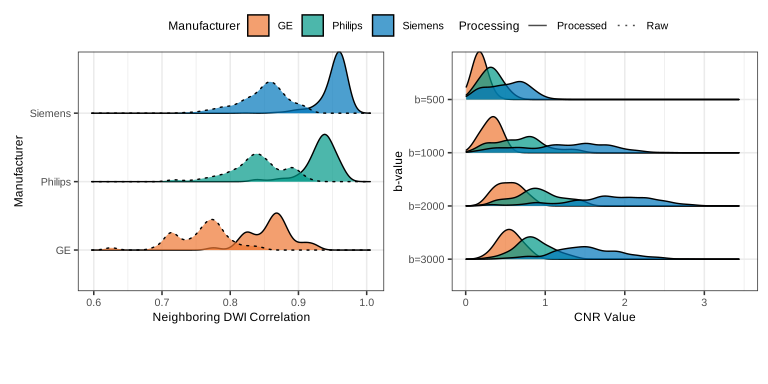
Below are distributions of automated QC metrics from HBCD visits V02 and V03. Higher Neighboring DWI Correlation (NDC; closer to 1) and Contrast-to-Noise Ratio (CNR) indicate better image quality. NDC can also be used as a covariate in analyses to account for QC variation.
Left: NDC calculated pre- and post-processing for each vendor using combined AP/PA scans (solid = processed, dashed = raw).
Right: Shell-wise CNR per vendor, calculated by Eddy. Because all data shown passed preliminary QC, we do not provide exclusion threshold recommendations. However, NDC and CNR are useful covariates when analyzing other derivatives.
References🔗
Alexander AL, Lee JE, Lazar M, Field AS. (2007). Diffusion tensor imaging of the brain. Neurotherapeutics, 4(3):316-29. 10.1016/j.nurt.2007.05.011
Basser PJ, Mattiello J, LeBihan D. (1994). MR diffusion tensor spectroscopy and imaging. Biophys J., 66(1):259-67. 10.1016/S0006-3495(94)80775-1
Cieslak M, Cook PA, He X, Yeh FC, Dhollander T, Adebimpe A, Aguirre GK, Bassett DS, Betzel RF, Bourque J, Cabral LM, Davatzikos C, Detre JA, Earl E, Elliott MA, Fadnavis S, Fair DA, Foran W, Fotiadis P, Garyfallidis E, Giesbrecht B, Gur RC, Gur RE, Kelz MB, Keshavan A, Larsen BS, Luna B, Mackey AP, Milham MP, Oathes DJ, Perrone A, Pines AR, Roalf DR, Richie-Halford A, Rokem A, Sydnor VJ, Tapera TM, Tooley UA, Vettel JM, Yeatman JD, Grafton ST, Satterthwaite TD. (2021). QSIPrep: an integrative platform for preprocessing and reconstructing diffusion MRI data. Nature Methods, 18(7):775-778. 10.1038/s41592-021-01185-5
Cieslak, M., Irfanoglu, M. O., Meisler, S. L., Salo, T., Raikes, A. C., Cook, P. A., Chung, A. W., Lee, E. G., Li, R., Li, X., Pecheva, D., Fair, D. A., Smyser, C. D., Harms, M. P., Landman, B. A., Wisnowski, J. L., Huang, H., Alexander, A. L., & Satterthwaite, T. D. (2025). Diffusion MRI processing in the HEALthy Brain and child development study: Innovations and applications. In bioRxiv. https://doi.org/10.1101/2025.11.10.687672
Jensen, J. H., Helpern, J. A., Ramani, A., Lu, H., & Kaczynski, K. (2005). Diffusional kurtosis imaging: the quantification of non-gaussian water diffusion by means of magnetic resonance imaging. Magnetic Resonance in Medicine, 53(6), 1432–1440. https://doi.org/10.1002/mrm.20508
Özarslan E, Koay CG, Shepherd TM, Komlosh ME, İrfanoğlu MO, Pierpaoli C, Basser PJ. (2013). Mean apparent propagator (MAP) MRI: a novel diffusion imaging method for mapping tissue microstructure. Neuroimage, 78:16-32. 10.1016/j.neuroimage.2013.04.016