Page Last Updated: October 29, 2025
Overview & EEG Protocols🔗
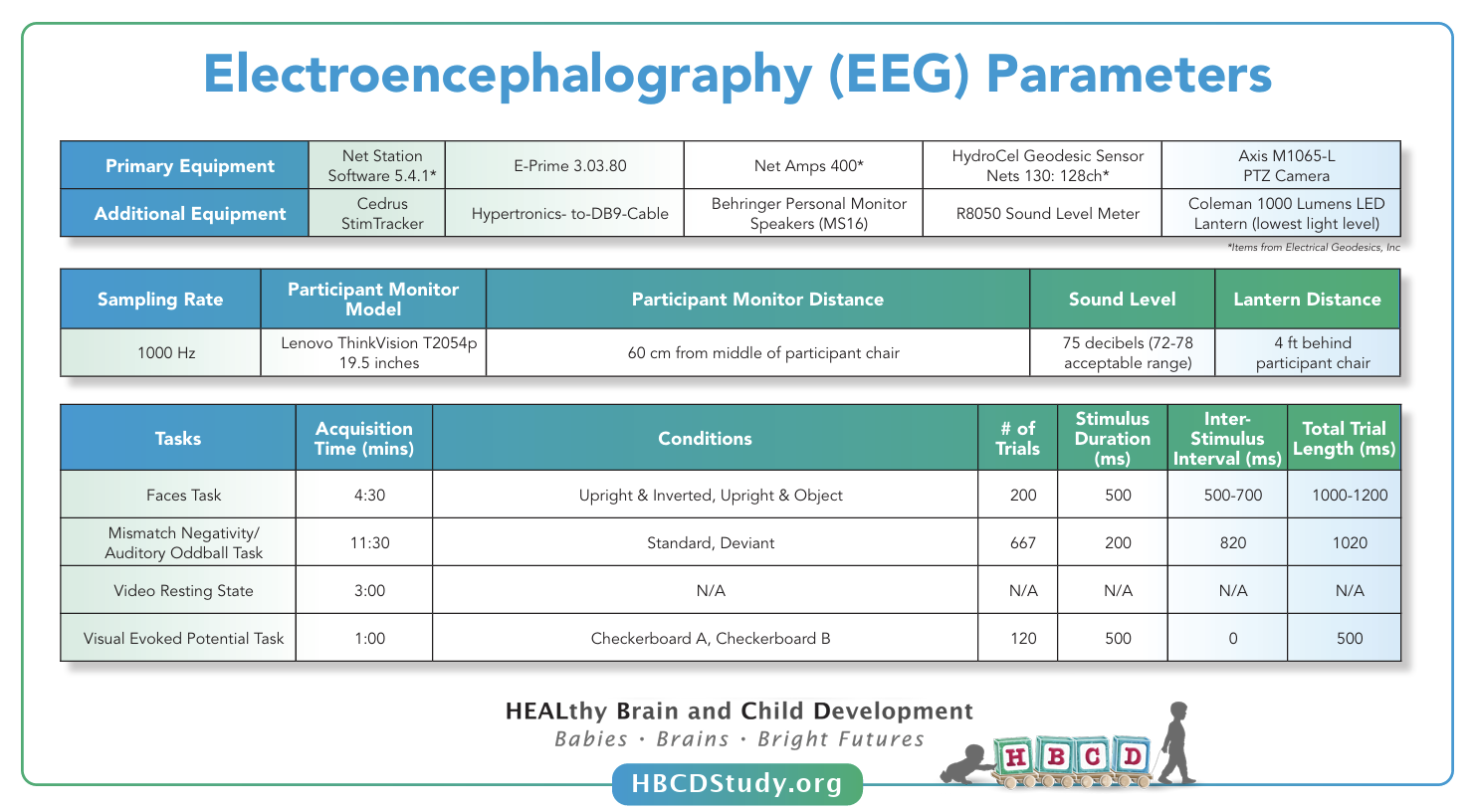
The HBCD study includes four electroencephalography (EEG) tasks collected during visits V03, V04, and V06:
- Auditory Mismatch Negativity (MMN)
- Faces (FACE)
- Video Resting State (RS)
- Visual Evoked Potential (VEP)
EEG Protocols🔗
EEG protocols are described in detail in Fox et al. 2024 and fully documented in HBCD EEG Acquisition Protocol.
Release Data🔗
The HBCD EEG data and EEG preprocessing outputs do not contain any personally identifiable information. It is important to consider that potentially stigmatizing conclusions could emerge from the inappropriate use of the EEG data together with available demographic information or questionnaires. Furthermore, all EEG tasks are all passive at the V03 age range and therefore conclusions should not be drawn about behavioral performance.
Methodologically, there are a number of best practices for responsible data use that will be included with each file. The first is selecting files that maintain a minimum trial threshold recommendation. For each task, there are three levels of quality control thresholds that can be used: (1) our QC thresholds used to provide feedback to sites on each upload, (2) a 30% trial retention threshold (which we use internally to indicate usability of an EEG recording), and (3) the reliability recommendations for each task.
Threshold recommendations by task:
- RS - 108 trials
- FACE - 15 trials for each condition of interest
- MMN - 30 trials for each condition of interest
- VEP - 36 trials.
An additional consideration for responsible use of the HBCD EEG dataset applies to disproportionate missing data. It is possible that some participant data may be systematically missing from this dataset by virtue of not meeting the QC thresholds. For instance, with infants that are inattentive and prone to fussing out during the EEG recording, more data may be removed from their datasets by our preprocessing scripts. A similar risk holds with participants who have thick or dense hairstyling and hair texture, which may impact capping success, impedance, and data quality (Adams et al., 2024). The consortium has proactively worked to address this risk by using scheduling procedures that are flexible to participants hairstyling routines and by purchasing 3 long pedestal nets per site in sizes appropriate for the V03, V04, and V06 visits (Adams et al., 2024; Mlandu et al., 2024). Preliminary analyses indicate that capping quality for visits where the long pedestal net was used have been consistent with capping quality seen for the dataset at large.
It is important to use these data in a manner which takes into account that physical and neurological differences between groups are not necessarily representative of intrinsic qualities of a given demographic group. Discussions around data patterns should be sensitive to societal factors. In addition, it is important to note that variation within demographic populations is greater than variation across populations. Demographic markers are categorical proxies that cannot capture or explain the causal mechanisms that may account for evident differences.
HBCD EEG Utilities
The EEG Core of the HBCD Data Coordinating Center (HDCC) has developed some helpful tools for extracting summary statistics and trial measures from HBCD EEG release data. We encourage all users to explore these resources at the HBCD EEG Utilities website.
Stimtracker Artifact
The MMN, VEP, and FACE task data for one participant included in the data release was found to contain an electrical noise artifact originating from the stimtracker device used for stimulus timing. All other participants' data were checked and confirmed to be artifact-free.
This artifact is most prominent in electrode E55 between the REF and COM electrodes, but is also visible in surrounding channels. It is time-locked to both stimulus onset and offset: as highlighted in the following EEG trace (MMN auditory oddball task in E55), the artifact presents as a negative deflection at onset and a positive deflection at offset.
Click here for information on how this artifact appears in time-frequency plots and ERP derivatives.
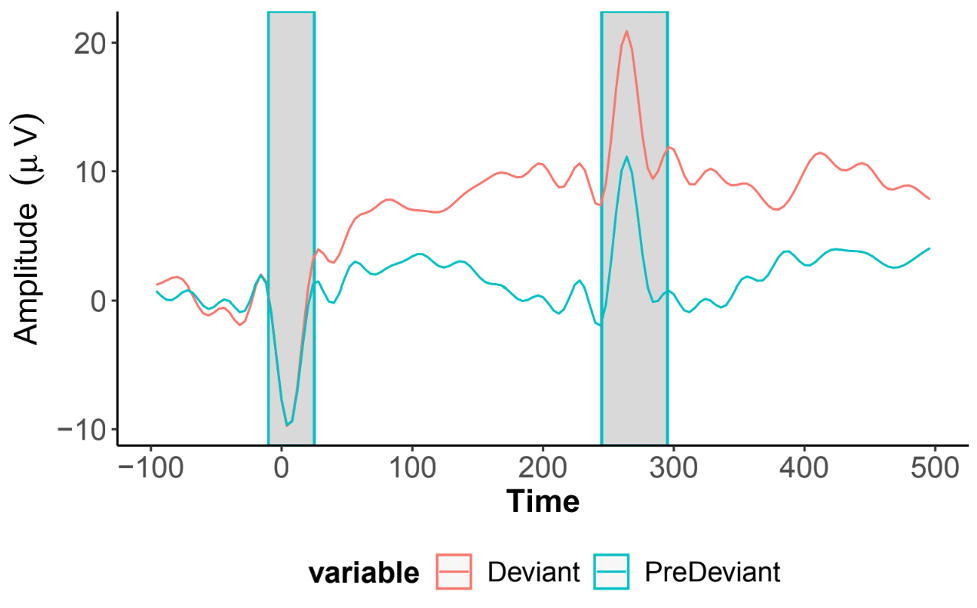
The EEG workgroup is currently developing a method of ICA correction to remove this artifact. In the meantime, it is recommended to exclude the MMN, VEP, and FACE tasks for this participant from analyses. The ID of the impacted participant along with this documentation is available to DUC users in the HBCD Private Release Notes accessible via the Lasso Help Center.
Task Updates Between V03 and V04/V06
The video content for the Resting State task and interstimulus interval (ISI) for the Auditory Mismatch Negativity task both changed between visits V03 and V04/V06 - see Fox et al. 2024 and Morr et al. 2002 for details. Also note that RS is not a true resting state as there is a visual stimulus present.
EEG release data include both file-based (raw and processed data files in modality-specific formats) and tabulated (instrument and derived data in a standardized table format) data. See the Data Structure Overview for a full explanation of these data types.
- Raw BIDS stored under subject- and session-specific
eeg/folders - Derivatives generated by the HBCD-MADE pipeline
- Tabulated data derived from HBCD-MADE pipeline outputs — see the full list of EEG-specific tables here
Each participant’s BIDS eeg/ folder contains task-specific EEG recordings (.set and .fdt files), along with channel metadata (*_channels.tsv and *_events.tsv). Electrodes are placed on either the head (acq-eeg) or chest (acq-ecg). Electrode placement information is stored in *_electrodes.tsv files, accompanied by *_coordsystem.json files that define the Cartesian coordinates.
The sourcedata/ subfolder includes impedance measurements (*_impedances.json) used to ensure good electrode contact and task event logs (*_eventlogs.txt) describing stimulus presentation timing.
See BIDS Conversion Procedures.
hbcd/
|__ rawdata/
    |__ sub-<ID>/
        |__ ses-<V0X>/
            |__ eeg/
                | # TASK ACQUISITIONS:
                |__sub-<ID>_ses-<V0X>_task-<FACE|MMN|RS|VEP>_acq-<eeg|ecg>_channels.tsv
                |__sub-<ID>_ses-<V0X>_task-<FACE|MMN|RS|VEP>_acq-<eeg|ecg>_eeg.set (+JSON)
                |__sub-<ID>_ses-<V0X>_task-<FACE|MMN|RS|VEP>_acq-<eeg|ecg>_events.tsv (+JSON)
                |__sub-<ID>_ses-<V0X>_task-<FACE|MMN|RS|VEP>_acq-eeg_eeg.fdt
                |
                | # ELECTRODE PLACEMENT:
                |__sub-<ID>_ses-<V0X>_acq-eeg_space-<CapTrak|CTF>_electrodes.tsv
                |__sub-<ID>_ses-<V0X>_acq-eeg_space-<CapTrak|CTF>_coordsystem.json
                |
                |__ sourcedata/
                    |__ sub-<ID>_ses-<V0X>_acq-eeg_impedances.json
                    |__ sub-<ID>_ses-<V0X>_task-<FACE|MMN|RS|VEP>_acq-eeg_eventlogs.txt
See details of the HBCD-MADE pipeline and outputs in the HBCD-MADE documentation. Below is an overview of the HBCD-MADE derivative file structure and key outputs.
hbcd/
|__ derivatives/
    |__ made/
        |__ sub-<ID>/
            |__ ses-<V0X>/
                |__ eeg/
                    |__ filtered_data/
                    |   |__ sub-<ID>_ses-<V0X>_task-<FACE|MMN|RS|VEP>_acq-eeg_desc-filtered_eeg.fdt
                    |   |__ sub-<ID>_ses-<V0X>_task-<FACE|MMN|RS|VEP>_acq-eeg_desc-filtered_eeg.set
                    |
                    |__ ica_data/
                    |   |__ sub-<ID>_ses-<V0X>_adjustReport.txt
                    |   |__ sub-<ID>_ses-<V0X>_desc-mergedICA_eeg.fdt
                    |   |__ sub-<ID>_ses-<V0X>_desc-mergedICA_eeg.set
                    |
                    |__ merged_data/
                    |   |__ sub-<ID>_ses-<V0X>_desc-merged_eeg.fdt
                    |   |__ sub-<ID>_ses-<V0X>_desc-merged_eeg.json
                    |   |__ sub-<ID>_ses-<V0X>_desc-merged_eeg.set
                    |
                    |__ processed_data/
                    |   |__ sub-<ID>_ses-<V0X>_task-FACE_desc-<F-TOPO>_topo.jpg
                    |   |__ sub-<ID>_ses-<V0X>_task-FACE_desc-oz_<diffERP|ERP>.jpg
                    |   |__ sub-<ID>_ses-<V0X>_task-MMN_desc-oz_<MMN-TOPO>_topo.jpg
                    |   |__ sub-<ID>_ses-<V0X>_task-MMN_desc-t7t8_<diffERP|ERP>.jpg
                    |   |__ sub-<ID>_ses-<V0X>_task-VEP_<desc-oz_ERP|topo>.jpg
                    |   |__ sub-<ID>_ses-<V0X>_task-<FACE|MMN|VEP>_acq-eeg_ERP.mat
                    |   |__ sub-<ID>_ses-<V0X>_task-<FACE|MMN|RS|VEP>_acq-eeg_desc-filteredprocessed_eeg.fdt
                    |   |__ sub-<ID>_ses-<V0X>_task-<FACE|MMN|RS|VEP>_acq-eeg_desc-filteredprocessed_eeg.set
                    |
                    |__ sub-<ID>_ses-<V0X>_acq-eeg_preprocessingReport.csv
                    |__ sub-<ID>_ses-<V0X>_task-<FACE|MMN|RS|VEP>_acq-eeg_MADEspecification.json

# Label Values Legend
<F-TOPO>: diffInvVsUpr, diffObjVsUp2, inverted, object, upright, upright2
<MMN-TOPO>: deviant, diffDevVsSta, diffDevVsPre, preDeviant, standard
Resources🔗
References🔗
Adams, E. J., Scott, M. E., Amarante, M., Ramírez, C. A., Rowley, S. J., Noble, K. G., & Troller-Renfree, S. V. (2024). Fostering inclusion in EEG measures of pediatric brain activity. Npj Science of Learning, 9(1), 27. https://doi.org/10.1038/s41539-024-00240-y
Debnath, R., Buzzell, G. A., Morales, S., Bowers, M. E., Leach, S. C., & Fox, N. A. (2020). The Maryland analysis of developmental EEG (MADE) pipeline. Psychophysiology, 57(6), e13580. https://doi.org/10.1111/psyp.13580
Fox, N. A., Pérez-Edgar, K., Morales, S., Brito, N. H., Campbell, A. M., Cavanagh, J. F., Gabard-Durnam, L. J., Hudac, C. M., Key, A. P., Larson-Prior, L. J., Pedapati, E. V., Norton, E. S., Reetzke, R., Roberts, T. P., Rutter, T. M., Scott, L. S., Shuffrey, L. C., Antúnez, M., Boylan, M. R., … Yoder, L. (2024). The development and structure of the Healthy Brain and Child Development (HBCD) study EEG Protocol. Developmental Cognitive Neuroscience, 69, 101447. https://doi.org/10.1016/j.dcn.2024.101447
Mlandu, N., McCormick, S. A., Davel, L., Zieff, M. R., Bradford, L., Herr, D., Jacobs, C. A., Khumalo, A., Knipe, C., Madi, Z., Mazubane, T., Methola, B., Mhlakwaphalwa, T., Miles, M., Nabi, Z. G., Negota, R., Nkubungu, K., Pan, T., Samuels, R., … Gabard-Durnam, L. J. (2024). Evaluating a novel high-density EEG sensor net structure for improving inclusivity in infants with curly or tightly coiled hair. Developmental Cognitive Neuroscience, 67(101396), 101396. https://doi.org/10.1016/j.dcn.2024.101396