Page Last Updated: December 3, 2025
APA Level 1 / Level 2🔗
pex_bm_apaConsideration of Mental Health Symptoms Experienced During Pregnancy
The co-occurrence of psychiatric symptoms and substance use during pregnancy is well-documented (Massey et al., 2011, Massey et al., 2012). Phenotypic risk in birthing parents may affect offspring neurodevelopment through both prenatal and postnatal mechanisms, beyond direct exposure alone (Estabrook et al., 2016, Massey et al., 2016, Massey et al., 2018). These factors may confound associations between exposures and neuroimaging or neurodevelopmental outcomes, but they also represent malleable targets for prevention and early intervention. When possible, incorporating parental mental health symptoms as covariates offers a robust strategy to account for these confounding influences.
Administration & Quality Control🔗
| Child Specific | No |
| Respondent | Pregnant Participant, Birth Parent, or Primary Caregiver |
| Administration | Self-administered in-person or remote |
| Visits | V01, V02, V03 |
| Completion Time | 5 min |
| Quality Control |
|
Instrument Details🔗
The HBCD mental health screening instrument is a highly sensitive screening tool for use in community samples. It has two levels, adapted from DSM-5 Self-Rated Level 1 and Level 2 Cross-Cutting Symptom Measures:
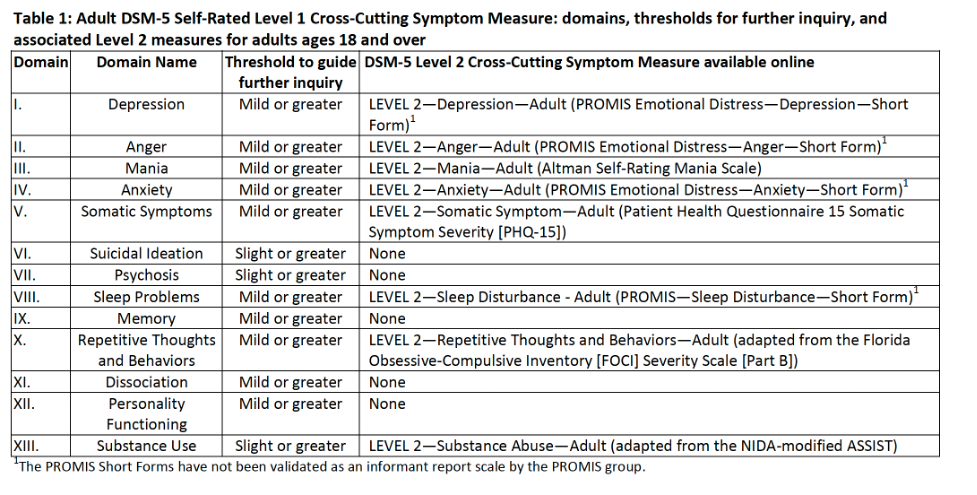
Level 1 includes 1 - 2 questions for each of 11 mental health domains Depression, Anger, Mania, Anxiety, Somatic Symptoms, Suicidal Ideation, Psychosis, Sleep Disturbance, Memory, Repetitive Behaviors, Dissociation. When symptoms were reported for Level 1, participants were subsequently administered corresponding Level 2 measures, which asked about additional symptoms associated with the following 8 mental health domains: Anxiety, Anger, Depression, Mania, Personality, Repetitive Behavior, Sleep, and Somatic symptoms.
Level 1 Modifications
HBCD excluded Personality Functioning and Substance Use present in the original measure (SU is captured by a separate set of instruments for HBCD - see measures listed here).
Gating Modifications
Gating was adapted for the HBCD study population so that participants proceeded automatically to the Level 2 measure for Personality Inventory without completing level 1. In addition, all participants answered the Level 1 questions for Depression and Somatic Symptoms, but proceeded to Level 2* questions irrespective of answers. Future publications should be sure to acknowledge the removal of Level 1 and 2 Substance Use and the gating mechanisms for Personality Inventory, Depression, and Somatic Symptoms.
*For HBCD, Level 2 symptom measures for Depression and Sleep Disturbance were replaced with the PROMIS Short Forms v1.0 Depression 8a questionnaire and Sleep Disturbance 8a. Level 2 additionally includes the Personality Inventory for DSM-5 Brief, which assesses 5 personality trait domains Negative Affect, Detachment, Antagonism, Disinhibition, Psychoticism.
Clinical Alerts
This measure was modified to alert HBCD study staff if responses to the Level 1 APA self-harm question ('Thoughts of actually hurting yourself?') or Level 2 APA Depression questionnaire (items from 'I felt worthless' to 'I felt that nothing could cheer me up') exceed thresholds of 0 and 32, respectively.
Response Option Changes
For HBCD, the response option ‘Decline to answer’ was added to all questions. The response option ‘Don’t know’ was also included at the beginning of data collection, but was subsequently removed. Questions answered with ‘Decline to answer’ or ‘Don’t know’ are marked as missing.
Level 1 items and scoring overview, including HBCD adaptations:
| * All items scored as 0=none, 1=slight, 2=mild, 3=moderate, 4=severe | |||
| Level 1 Items* | Gate to level 2 | Level 2 measure | |
|---|---|---|---|
| Depression | depr_001, depr_002 | administered, but all to level 2 (no gating) | PROMIS Adult Short Form v1.0 – Depression 8a |
| Anger | apa_1_anger_001 | apa_1_anger_001 ge 2 | LEVEL 2—Anger—Adult (PROMIS Emotional Distress—Anger—Short Form) |
| Mania | apa_1_mania_001, apa_1_mania_002 | apa_1_mania_001 or apa_1_mania_002 ge 2 | LEVEL 2—Mania—Adult (Altman Self-Rating Mania Scale) |
| Anxiety | apa_1_anx_001 | apa_1_anx_001 ge 2 | LEVEL 2—Anxiety—Adult (PROMIS Emotional Distress—Anxiety—Short Form) |
| Somatic | apa_1_somat_001, apa_1_somat_002 | administered, but all to level 2 (no gating) | LEVEL 2—Somatic Symptom—Adult (Patient Health Questionnaire 15 Somatic Symptom Severity [PHQ-15]) |
| Self-harm | apa_1_suic_001 | no level 2 | no level 2 |
| Psychosis | apa_1_psych_001, apa_1_psych_002 | no level 2 | no level 2 |
| Sleep | apa_1_sleep_001 | apa_1_sleep_001 ge 2 | Adult v1.0 - Sleep Disturbance 8a |
| Memory | apa_1_memo_001 | no level 2 | no level 2 |
| Repetitive | apa_1_repet_001, apa_1_repet_002 | apa_1_repet_001 or apa_1_repet_002 ge 2 | LEVEL 2—Repetitive Thoughts and Behaviors—Adult (adapted from the Florida Obsessive-Compulsive Inventory [FOCI] Severity Scale [Part B]) |
| Dissociation | apa_1_disso_001 | no level 2 | no level 2 |
| Personality | not administered | not administered- all to personality inventory | Personality inventory for DSM-5 Brief |
| Substance use | not administered | not administered | not administered |
Level two items and scoring overview, including HBCD adaptations. Scores were derived following linked documentation and as documented in the ‘Notes’ column.
| Level 2 Items | Scoring | Notes | |
|---|---|---|---|
| Depression | apa_2_depr_001-apa_2_depr_008 | sum all items; look up t-score | All items must be answered in order to produce a valid score using the scoring tables |
| Anger | apa_2_anger_001-apa_2_anger_005 | sum all items; look up t-score | One missing item, pro-rate ((raw score * 5)/(number answered)). Two or more missing items should not be scored |
| Mania | apa_2_mania_001-apa_2_mania_005 | sum all items; score of ge 6 indicates high probability of mania | One missing item, pro-rate ((raw score * 5)/(number answered)). Two or more missing items should not be scored |
| Anxiety | apa_2_anx_001-apa_2_anx_007 | sum all items; look up t-score | Less than 3 missing items, pro-rate ((raw score *7)/(number answered)). Three or more missing items should not be scored |
| Somatic | apa_2_somat_001-apa_2_somat_015 | sum all items; interpreted using the Interpretation Table for the PHQ-15 Somatic Symptom Severity scale | Less than 4 missing items, pro-rate ((raw score *15)/(number answered)). Four or more missing items should not be scored |
| Sleep | apa_2_sleep_001-apa_2_sleep_008 | sum all items; look up t-score | All items must be answered in order to produce a valid score using the scoring tables |
| Repetitive | apa_2_repet_001-apa_2_repet_005 | sum all items; look up t-score | One missing item, pro-rate ((raw score * 5)/(number answered)). Two or more missing items should not be scored |
| Personality | apa_2_pers_001-apa_2_pers_025 | sum all items; look up t-score | Six missing item, pro-rate ((raw score *25)/(number answered)). Seven or more missing items should not be scored |
References🔗
Doss, R. A., & Lowmaster, S. E. (2022). Validation of the DSM-5 Level 1 Cross-Cutting Symptom Measure in a Community Sample. Psychiatry Research, 318, 114935. https://doi.org/10.1016/j.psychres.2022.114935
Estabrook, R., Massey, S. H., Clark, C. A. C., Burns, J. L., Mustanski, B. S., Cook, E. H., O’Brien, T. C., Makowski, B., Espy, K. A., & Wakschlag, L. S. (2016). Separating family-level and direct exposure effects of smoking during pregnancy on offspring externalizing symptoms: Bridging the behavior genetic and behavior teratologic divide. Behavior Genetics, 46(3), 389–402. https://doi.org/10.1007/s10519-015-9762-2
Massey, S. H., Lieberman, D. Z., Reiss, D., Leve, L. D., Shaw, D. S., & Neiderhiser, J. M. (2011). Association of clinical characteristics and cessation of tobacco, alcohol, and illicit drug use during pregnancy. The American Journal on Addictions. https://doi.org/10.1111/j.1521-0391.2010.00110.x
Massey, S. H., Mroczek, D. K., Burns, J. L., Clark, C. A. C., Espy, K. A., & Wakschlag, L. S. (2018). Positive parenting behaviors in women who spontaneously quit smoking during pregnancy: Clues to putative targets for preventive interventions. Neurotoxicology and Teratology, 67, 18–24.https://doi.org/10.1016/j.ntt.2018.02.003
Massey, S. H., Neiderhiser, J. M., Shaw, D. S., Leve, L. D., Ganiban, J. M., & Reiss, D. (2012). Maternal self concept as a provider and cessation of substance use during pregnancy. Addictive Behaviors, 37(8), 956–961. https://doi.org/10.1016/j.addbeh.2012.04.002
Massey, S. H., Reiss, D., Neiderhiser, J. M., Leve, L. D., Shaw, D. S., & Ganiban, J. M. (2016). Maternal personality traits associated with patterns of prenatal smoking and exposure: Implications for etiologic and prevention research. Neurotoxicology and Teratology, 53, 48–54. https://doi.org/10.1016/j.ntt.2015.11.010
Roche, M. J., Pincus, A. L., & Cole, P. E. (2019). Linking dimensions and dynamics in psychopathology research: An example using DSM-5 instruments. Journal of Research in Personality, 82, 103852. https://doi.org/https://doi.org/10.1016/j.jrp.2019.103852