Page Last Updated: October 16, 2025
Faces Task🔗
The Faces task (FACE) (v.11.29.23) assesses child and infant face processing abilities as well as the underlying neural activity supporting face and object processing. ERPs are computed as a function of repeated presentation of faces and objects. The ERPs index different stages of processing including attention, perception, categorization, individuation and memory. The ERP components elicited by the Faces task are the P1, N290, and P400 components. See Fox et al. (2024) for additional information on the rationale for task/stimulus development and ERP findings from pilot data.
Task Details🔗
ERPs indexing different stages of processing are computed from repeated presentations of faces and objects. In the Faces task, the ERP components include P1, N290, and P400. If the child loses attention, an attention getter may be used. The stimulus set includes 36 unique images, with women with neutral expressions, spanning the following self-identified demographics: Indigenous, Black, White, Asian, Hispanic/Latino, and South Asian.
Face task schematic (Face vs. Object) & Task Details:
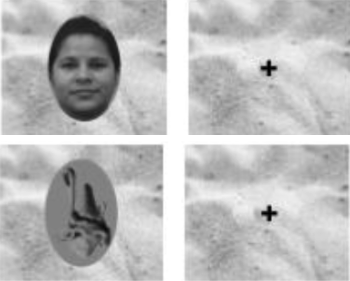
Timing Details:Block 1: 50 trials of upright faces and 50 trials of inverted faces
Block 2: 50 trials of upright faces and 50 trials of objects
Stimulus duration: 500 ms
Interstimulus interval: 600-700 ms
Total trial length: 110-1200 ms
References🔗
Barry-Anwar, R., Riggins, T., & Scott, L. S. (2024). Electrophysiology in developmental populations: Key methods and findings. In K. Cohen Kadosh (Ed.), Oxford Handbook of Developmental Cognitive Neuroscience. Oxford Library of Psychology. Oxford Academic. https://doi.org/10.1093/oxfordhb/9780198827474.013.3
Fox, N. A., Pérez-Edgar, K., Morales, S., Brito, N. H., Campbell, A. M., Cavanagh, J. F., Gabard-Durnam, L. J., Hudac, C. M., Key, A. P., Larson-Prior, L. J., Pedapati, E. V., Norton, E. S., Reetzke, R., Roberts, T. P., Rutter, T. M., Scott, L. S., Shuffrey, L. C., Antúnez, M., Boylan, M. R., … Yoder, L. (2024). The development and structure of the Healthy Brain and Child Development (HBCD) study EEG Protocol. Developmental Cognitive Neuroscience, 69, 101447. https://doi.org/10.1016/j.dcn.2024.101447
Markant, J., & Scott, L. S. (2018). Attention and perceptual learning interact in the development of the other-race effect. Current Directions in Psychological Science, 27(3), 163–169. https://doi.org/10.1177/0963721418769884
Scherf, K. S., & Scott, L. S. (2012). Connecting developmental trajectories: Biases in face processing from infancy to adulthood. Developmental Psychobiology, 54(6), 643–663. https://doi.org/10.1002/dev.21013