Page Last Updated: November 21, 2025
USDTL Urine Toxicology (Maternal)🔗
bio_bm_biosample_urineContinuous Variables
For all toxicology screens, continuous variables should be interpreted with caution based on the threshold limits of quantification (LOQs), or the cutoff concentration used to categorize metabolites as positive or negative. LOQs are provided in Table 1. Urine Assay Thresholds for Analytes.
Urinary Concentration Corrections
Urine concentrations vary by participant. Urinary concentration corrections can be made using creatinine results from sample validation or specific gravity. Creatinine values are provided for researchers who wish to adjust/correct for urinary concentration in continuous measures or apply different thresholds.
Large Gaps Between Collection and Analysis Dates
A substantial number of samples show unusually long intervals between collection and analysis (e.g., over 100–300 days, compared to the 30-day limit specified by internal SOPs). We are working to determine whether this reflects a data entry or site-level issue and will provide an update once more information is available.
Administration & Quality Control🔗
| Respondent | Pregnant/postpartum person |
| Administration | Self-collected |
| Visits | V01 |
| Completion Time | 5 min |
| Quality Control | Examine assay ranges and categorical versus continuous measures. |
Instrument Details🔗
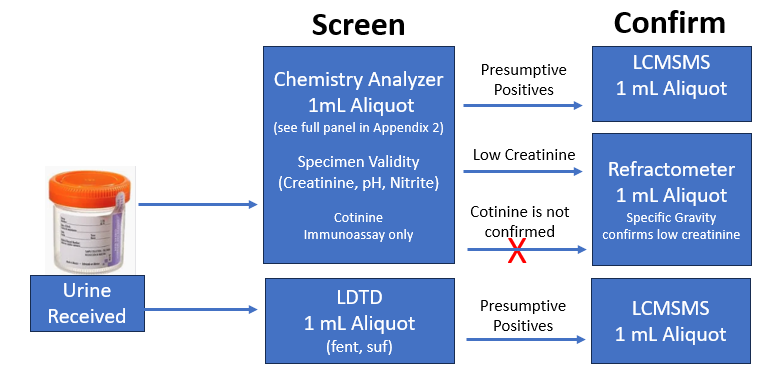
These data are the results of urine toxicology assays. Screening results for substances are determined to be positive or negative based on predefined thresholds (Table 1), or invalid - see Validation Procedures. Confirmatory tests are used to confirm the results of screening for any substance analyte (e.g. Amphetamine (c_amp_u)), which are grouped into different classes by analyte screening tests and analyte confirmatory tests (Table 2).
| Analyte | LODLimit of detection (ng/mL) | LOQLimit of quantification (ng/mL) | Cutoff (ng/mL) | Detection Window |
|---|---|---|---|---|
| Amphetamine | 50 | 100 | 250 | 2-3 days |
| Methamphetamine | 50 | 100 | 250 | 2-3 days |
| MDA | 50 | 100 | 250 | 2-3 days |
| MDMA | 50 | 100 | 250 | 2-3 days |
| MDEA | 50 | 100 | 250 | 2-3 days |
| Carboxy-delta-9-THC | 3 | 7.5 | 15 | 2-5 days for casual use; 10-14 for chronic use |
| Carboxy-delta-8-THC | 3 | 7.5 | 15 | No consensus |
| Carboxy-cannabidiol | 10 | 25 | 50 | No consensus |
| Cotinine Based on DRI® Cotinine assay for the qualitative and semiquantitative determination of Cotinine | 34 | 34 | 500 | Up to 7 days |
| Benzoylecgonine | 20 | 50 | 100 | 2-3 days |
| 6-MAM | 2 | 4 | 10 | 8 hours |
| Codeine | 10 | 50 | 100 | 2-3 days |
| Hydrocodone | 10 | 50 | 100 | 2-3 days |
| Hydromorphone | 10 | 50 | 100 | 2-3 days |
| Morphine | 10 | 50 | 100 | 2-3 days |
| Oxycodone | 60 | 120 | 300 | 2-3 days |
| Oxymorphone | 60 | 120 | 300 | 2-3 days |
| Phencyclidine | 5 | 12.5 | 25 | 2-3 days |
| Methadone | 60 | 120 | 300 | 2-3 days |
| EDDP | 60 | 120 | 300 | 2-3 days |
| Amobarbital | 40 | 100 | 200 | 2-4 days |
| Butalbital | 40 | 100 | 200 | 2-4 days |
| Pentobarbital | 40 | 100 | 200 | 1-2 days |
| Phenobarbital | 40 | 100 | 200 | 2 weeks |
| Secobarbital | 40 | 100 | 200 | 1-2 days |
| α-Hydroxyalprazolam | 20 | 40 | 100 | 1-4 days |
| α -Hydroxytirazolam | 20 | 40 | 100 | 1-4 days |
| α -Hydroxymidazolam | 20 | 40 | 100 | 1-4 days |
| 2-Hydroxyethylflurazepam | 20 | 40 | 100 | 1-4 days |
| 7-Aminoflunitrazepam | 20 | 40 | 100 | 1-4 days |
| 7-Aminoclonazepam | 20 | 40 | 100 | 1-4 days |
| 7-Aminonitrazepam | 20 | 40 | 100 | 1-4 days |
| Lorazepam | 20 | 40 | 100 | 1-4 days |
| Nordiazepam | 20 | 40 | 100 | 1-4 days |
| Oxazepam | 20 | 40 | 100 | 1-4 days |
| Temazepam | 20 | 40 | 100 | 1-4 days |
| Norpropoxyphene | 10 | 50 | 100 | 2-3 days |
| Ketamine | 10 | 50 | 100 | 2-3 days |
| Norketamine | 10 | 50 | 100 | 2-3 days |
| Normeperidine | 40 | 100 | 200 | 2-3 days |
| Tramadol | 40 | 80 | 200 | 2-3 days |
| Buprenorphine | 1 | 2 | 5 | 2-3 days |
| Norbuprenorphine | 1 | 2 | 5 | 2-3 days |
| Ethyl glucuronide | 50 | 100 | 100 | 2-3 days |
| Ethyl sulfate | 12.5 | 25 | 25 | 2-3 days |
| Zolpidem | 4 | 8 | 20 | 2-3 days |
| Zolpidem Carboxylic Acid | 4 | 8 | 20 | 2-3 days |
| Carisoprodol | 10 | 20 | 50 | 2-3 days |
| Meprobamate | 10 | 20 | 50 | 2-3 days |
| Analyte | LOD (pg/mL) | LOQ (pg/mL) | Cutoff (pg/mL) | Detection Window |
| Fentanyl | 40 | 40 | 100 | 2-3 days |
| Norfentanyl | 40 | 40 | 100 | 2-3 days |
| Alfentanil | 40 | 40 | 100 | 2-3 days |
| Sufentanil | 40 | 40 | 100 | 2-3 days |
| Norsufentanil | 40 | 40 | 100 | 2-3 days |
| Class | Screening Test | Confirmatory Test (positive screen reflex) |
|---|---|---|
|
stimulant (
c_any_stim_u) |
amp (
s_amp_u) |
Amphetamine (c_amp_u) |
Methamphetamine (c_meth_u) |
||
|
mdma (
s_mdma_u) |
MDM (c_mdm_u) |
|
MDA (c_mda_u) |
||
MDEA (c_mdea_u) |
||
coc (s_coc_u) |
Benzoylecgonine (c_ben_u) |
|
|
cannabinoid (
c_any_cannabinoid_u) |
thc (
s_thc_u) |
Carboxy-delta-9-THC (c_delta-9-THC_u) |
Carboxy-Cannabidiol (c_cannabidiol_u) |
||
Carboxy-delta-8-THC (c_delta-8-THC_u) |
||
|
barbiturate (
c_any_barb_u) |
bar (
s_bar_u) |
Amobarbital (c_amobarb_u) |
Secobarbital (c_secobarb_u) | ||
Pentobarbital (c_pentobarb_u) | ||
Phenobarbital (c_phenobarb_u) | ||
Butalbital (c_butalbital_u) | ||
|
benzodiazepine (
c_any_benzo_u) |
benz (
s_benz_u) |
Oxazepam (c_oxaz_u) |
Nordiazepam (c_nord_u) | ||
Temazepam (c_tema_u) | ||
Hydroxymidazolam (c_homi_u) | ||
Alphahydroxyalprazolam (c_aha_u) | ||
2hydroxyethylflurazepam (c_2hef_u) | ||
7Aminoclonazepam (c_7ac_u) | ||
7Aminoflunitrazepam (c_7af_u) | ||
7Aminonitrazepam (c_7an_u) | ||
Alphahydroxytriazolam (c_aht_u) | ||
Lorazepam (c_lor_u) | ||
|
opioids (
c_any_opioid_u) |
opi (
s_opi_u) |
Codeine (c_cod_u) |
Morphine (c_mor_u) | ||
MAM (c_mam_u) | ||
Hydrocodone (c_hydroc_u) | ||
Hydromorphone (c_hydrom_u) | ||
mtd ( s_mtd_u) |
Methadone (c_mtd_u) | |
EDDP (c_eddp_u) | ||
ppx (s_ppx_u) |
Norpropoxyphene (c_nppx_u) |
|
|
oxyc (
s_oxyc_u) |
Oxycodone (c_oxyc_u) |
|
Oxymorphone (c_oxym_u) |
||
mep (s_mep_u) |
Normeperidine (c_nmep_u) |
|
tram (s_tram_u) |
Tramadol (c_tram_u) |
|
fent ( s_fent_u) |
Fentanyl (c_fent_u) |
|
Norfentanyl (c_nfent_u) | ||
Alfentanil (c_afent_u) | ||
suf ( s_suf_u) |
Norsufentanil (c_nsuf_u) |
|
Sufentanil (c_suf_u) | ||
|
bup (
s_bup_u) |
Buprenorphine (c_bup_u) | |
Norbuprenorpine (c_nbup_u) | ||
|
muscle relaxant (
c_any_mscrlx_u) |
crs (
s_crs_u) |
Carisoprodol (c_crs_u) |
Meprobamate (c_mepb_u) | ||
ethanol ( c_ethanol_u) |
etgeia (
s_etgeia_u) |
EthylGluc-0100 (c_ethglu_u) |
EthylSul-100 (c_ethsyl_u) | ||
|
sedative (
c_sedative_u) |
zol (
s_zol_u) |
Zolpidem (c_zol_u) |
Zolpidem CA (c_zolc_u) |
||
dissociative anesthetic ( c_disanesth_u) |
ket ( s_ket_u) |
Ketamine (c_ket_u) |
Norketamine (c_nket_u) | ||
pcp (s_pcp_u) |
Phencyclidine (c_pcp_u) | |
nicotine (c_nicotine_u) |
Cotinine (c_cot_u) |
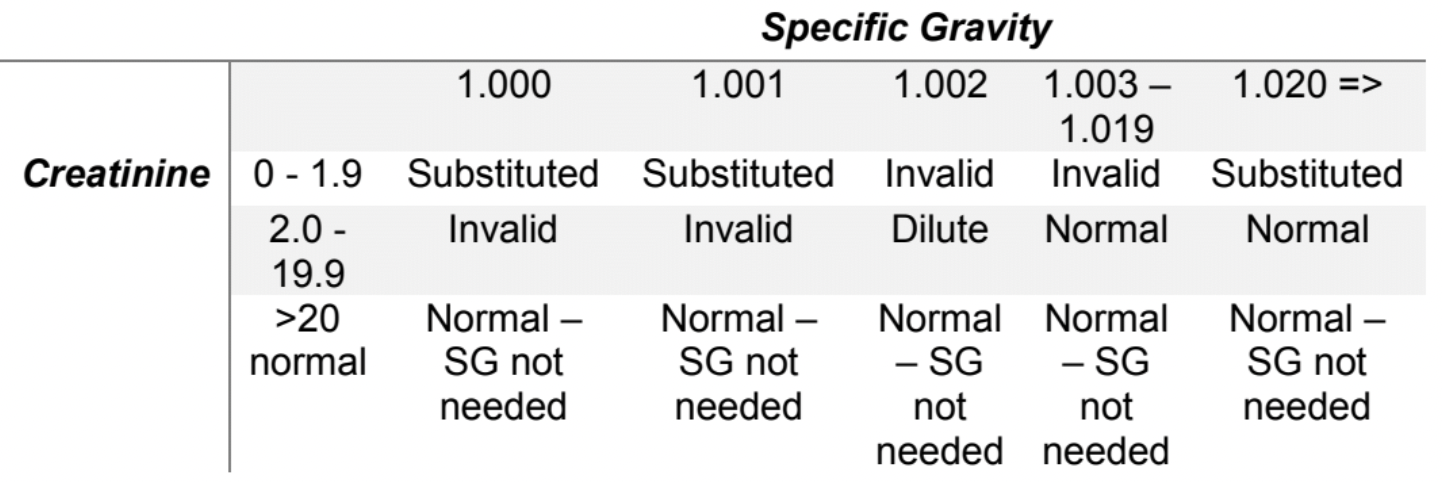
Assay results may be scored as invalid if specimens are identified as dilute, substituted, adulterated, or otherwise insufficient based on validation. Validation is based on creatinine, pH, and nitrite measurements. Only specimens with low creatinine (< 20 mg/dL) are confirmed using specific gravity via a refractometer (decision grid below), and the creatinine analysis is repeated to rule out issues with the first analysis (e.g. sample mix-ups, air bubble in a line on the instrument, etc.).
Final results for each substance follows these rules:
- If the confirmatory test for any substance analyte (e.g. Amphetamine (
c_amp_u)) is positive based on predefined thresholds (Table 1), the class-level (c_any_stim_u) and sample-level (c_any_specimen_u) are also positive (value =1). - Otherwise, if the substance analyte confirmatory tests are negative (e.g.,
c_ethglu_uandc_ethsyl_u, values = 0) then class-level (e.g.,c_etgeia_u) are negative (value =0). If all classes are negative (value = 0), then sample-level (e.g.,c_any_specimen_u) are negative (value = 0). - Finally, if any substance analyte confirmatory tests are invalid (value = 3) then that class-level, and sample-level values are also invalid (value = 3).
Table 3. Screening Result Scoring
| Level | Result Type | Example | Options |
|---|---|---|---|
| Specimen | Confirmatory results (presence of any analyte) | c_any_specimen_u |
1=positive; 0=negative; 3=invalid |
| Class | Confirmatory results (presence of any analyte in class) | c_any_stim_u |
1=positive; 0=negative; 3=invalid |
| Analyte | Screening results | s_amp_u |
1=positive; 0=negative; 3=invalid |
| Confirmatory results | c_amp_u |
concentration value | |
| Confirmatory results - categorical | c_amp_u_cat** |
1=positive; 0=negative; 3=invalid; 4=screen negative |
c_nicotine_u.
References🔗
Sullivan, E. L., Bogdan, R., Bakhireva, L., Levitt, P., Jones, J., Sheldon, M., Croff, J. M., Thomason, M., Lo, J. O., MacIntyre, L., Shrivastava, S., Cioffredi, L.-A., Edlow, A. G., Howell, B. R., Chaiyachati, B. H., Lashley-Simms, N., Molloy, K., Lam, C., Stoermann, A. M., … HBCD Biospecimens Workgroup. (2024). Biospecimens in the HEALthy Brain and Child Development (HBCD) study: Rationale and protocol. Developmental Cognitive Neuroscience, 70(101451), 101451. https://doi.org/10.1016/j.dcn.2024.101451